A rolling tote is the smartest solution for anyone who regularly carries heavy loads over meaningful distances. Combining the open-top accessibility of a traditional tote bag with the effortless mobility of a wheeled base and retractable handle, the rolling tote has become one of the most searched bag categories in 2026, with brands like Hulken Rolling Tote leading the market in versatility and durability. Whether you are a teacher transporting daily materials, a shopper handling large grocery runs, a crafter moving supplies, or a traveler who needs a carry-on alternative, this complete guide covers everything you need to choose the perfect rolling tote for your lifestyle, load, and budget.
What Is a Rolling Tote
A rolling tote is a hybrid bag that combines the open-top accessibility and soft-sided construction of a traditional tote bag with a wheeled base and retractable handle system that allows it to be rolled rather than carried. It sits in a unique product category between the full rigidity of hard-shell luggage and the complete flexibility of a shoulder bag.
The appeal of the rolling tote is practical and immediate. It gives you the ability to load a bag generously without the physical cost of carrying that weight on your shoulder, arm, or back. When the bag is manageable weight-wise, you carry it. When it gets heavy, you roll it. That dual capability makes the rolling tote one of the most versatile bag formats available for everyday use.
Rolling totes exist across an enormous range of sizes, materials, price points, and intended use cases. You will find rolling totes designed specifically for grocery shopping, for teacher use, for craft supply transport, for carry-on airline travel, and for professional healthcare workers who need to move supplies between rooms or buildings without lifting heavy loads repeatedly throughout the day.
The core design is consistent across all variations: a soft-sided bag body with a wheeled base, typically two inline wheels at the bottom rear edge, and a retractable or fixed handle at the top or back that allows the bag to be tilted and rolled smoothly on most surfaces.
Who Actually Needs a Rolling Tote
The rolling tote solves a specific physical problem. Anyone who regularly carries a heavy bag over a distance that strains their shoulder, back, or arms will find genuine value in making the switch to a wheeled format.
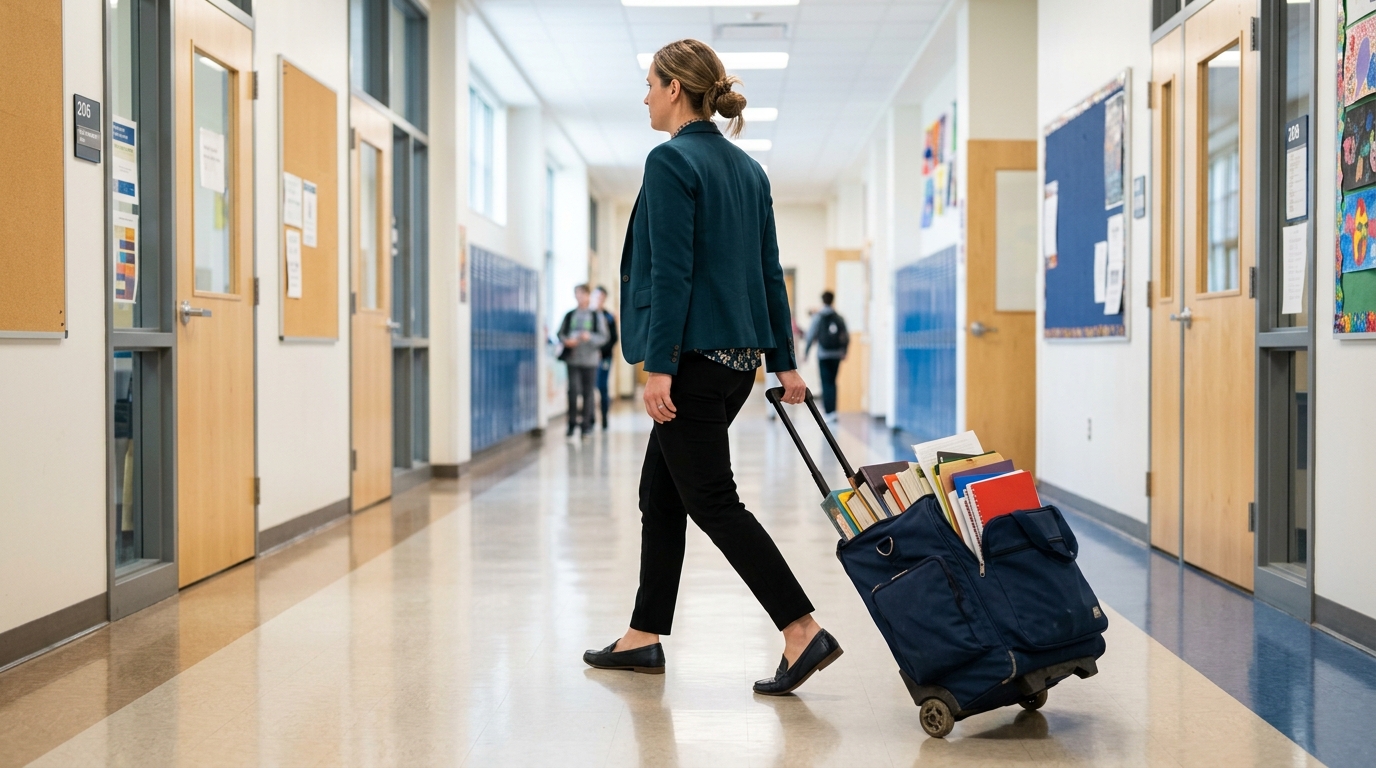
Teachers and educators are among the most consistent advocates for rolling totes. The volume of materials, textbooks, graded assignments, personal items, and school supplies that a teacher transports between home and school every single workday creates a cumulative physical burden that rolling totes significantly reduce. Teachers who switch to rolling totes often report immediate improvement in shoulder and back comfort within the first week of use.
Shoppers who regularly purchase large grocery or retail hauls, particularly those who use public transportation or walk significant distances from parking to stores and back, find rolling totes genuinely transformative. The ability to load a tote generously and roll it to the car, bus stop, or building entrance rather than straining with loaded shopping bags changes the entire experience of the errand.
Healthcare workers including nurses, home health aides, and physical therapists who carry medical supplies and patient records between locations throughout a working shift are increasingly using rolling totes as a professional tool rather than a personal convenience. The ergonomic benefit of not repeatedly lifting and carrying heavy bags across the course of a demanding shift is directly relevant to career longevity and physical health.
Crafters, sewists, knitters, and art supply enthusiasts have also built a strong community of rolling tote users. The sheer volume of materials that serious crafters transport to classes, guild meetings, and workshops creates exactly the weight and bulk problem that rolling totes were designed to solve.
Rolling Tote vs Regular Tote Bag
The comparison between a rolling tote and a standard tote bag comes down to one central trade-off: convenience against weight.
A regular tote bag is lighter when empty, more flexible in how it conforms to irregular loads, typically less expensive, and easier to store when not in use. It works perfectly well for lighter loads that remain manageable over the distances you need to cover. For trips where you are carrying five or ten pounds for a short distance, a standard tote bag is genuinely the better tool.
The rolling tote becomes clearly superior the moment the load grows heavy enough to cause discomfort, or the distance over which you are carrying the load extends long enough to create physical strain. A bag that weighs fifteen or twenty pounds on your shoulder across a parking lot, up stairs, through a building, and then home again at the end of a long day represents a meaningful physical burden. That same bag rolled behind you requires almost no physical effort regardless of its weight.
Rolling totes are larger when empty than the tote bags they replace, which means storage becomes a consideration. If you are short on closet or cabinet space, the physical footprint of a rolling tote when stored needs to be factored into the purchasing decision.
Rolling Tote vs Rolling Suitcase
The rolling tote and the rolling suitcase serve some overlapping purposes but are genuinely different tools suited to different situations.
A rolling suitcase, even a small carry-on, is designed primarily for travel. Its hard or semi-hard construction protects contents during transport, its organizational systems are optimized for packed clothing and toiletries, and its form factor is designed to comply with airline size restrictions. Suitcases typically stand upright on four spinner wheels, which makes them easy to maneuver in airports but less practical in settings where you need to tip the bag back and roll it on two wheels.
A rolling tote is designed for the gap between a shoulder bag and a suitcase. It is typically smaller than a carry-on suitcase, more flexible in how it opens and provides access to its contents, and more suited to use as an everyday bag rather than a travel-specific piece of luggage. The open or zip-top format of most rolling totes allows easy access to contents throughout the day rather than requiring you to lay the bag flat and open it fully the way a suitcase requires.
For short trips where a full suitcase feels excessive, a large rolling tote can serve as both the travel bag and the everyday bag on arrival, eliminating the need to manage two separate pieces of luggage.
Key Features to Look for in a Rolling Tote
Selecting the right rolling tote requires evaluating several specific design and construction elements that determine how well the bag performs over its lifetime. Not all rolling totes are built to the same standard, and the differences in quality become apparent quickly under regular use.
The quality of the wheels is the single most important factor in a rolling tote’s long-term usability. Wheels that are too small, made from low-quality plastic, or poorly mounted to the bag body will fail quickly under regular use with heavy loads. Look for wheels with a diameter of at least 2 inches, constructed from hard nylon or polyurethane, and mounted on a metal axle rather than a thin plastic rod.
The handle system deserves careful evaluation. Retractable handles should extend and collapse smoothly, lock securely at the extended position without wobbling, and retract fully when not in use without needing to be forced into position. Fixed non-retractable handles should be positioned so they do not interfere with loading and unloading the bag.
The base reinforcement of the bag is critical for heavy-use rolling totes. The bottom of the bag where the wheels are mounted takes the greatest structural stress in normal use. Bags with a reinforced base plate, typically made from hard plastic or multiple layers of board stiffening, maintain their shape and structural integrity significantly better than bags with flexible bottom panels.
Wheel Quality and What Makes It Matter
The wheel system on a rolling tote is the component most likely to determine whether the bag lasts months or years. Cheap wheels on inexpensive rolling totes are the most common failure point reported by consumers across review platforms, and wheel failure typically makes the bag unusable rather than simply less convenient.
Wheel diameter determines how well the bag handles rough surfaces. A small-diameter wheel that works reasonably on smooth tile or hardwood floor will struggle over sidewalk cracks, gravel paths, and the irregular surfaces of parking lots. Larger diameter wheels handle surface irregularities more smoothly and also require less effort to maintain rolling momentum.
Wheel material affects both durability and noise. Hard plastic wheels are lightweight but can be noisy on hard surfaces and may crack under heavy loads over time. Rubber or polyurethane wheels roll more quietly and absorb surface vibration better, which translates to both a more comfortable rolling experience and longer wheel life.
The mounting of the wheels to the bag frame determines how much lateral stress the mounting points receive during normal use. Wheels that are mounted through a base plate distribute rolling stress across a wider area of the bag’s base, which is significantly more durable than wheels mounted only to the outer fabric layer of the bag.
Handle Systems on Rolling Totes
Rolling tote handle systems fall into two categories: retractable telescoping handles and fixed handles. Each has specific advantages that make one or the other more appropriate for different use patterns.
Retractable telescoping handles are the most common format in rolling totes across all price points. They extend to a comfortable rolling height, typically 36 to 40 inches from the floor at full extension, and collapse into the bag when not in use. The retractable format is more versatile because it allows the bag to be used as a conventional carried bag without a protruding handle getting in the way.
The quality of retractable handles varies enormously. Low-quality telescoping handles have two failure modes: the locking mechanism that holds the handle at the extended position fails and allows the handle to collapse under load, or the retraction mechanism sticks and requires force to move the handle back to the stored position. Either failure makes the bag significantly less convenient and can be a safety concern if the handle collapses unexpectedly while you are pulling the bag.
Fixed handles, found on simpler rolling tote designs, are attached permanently to the back panel of the bag at a single height. They cannot be adjusted for user height, which can be a limitation for taller users who find themselves bending uncomfortably while rolling. Fixed handles typically have no failure modes since there are no mechanical components, which is a genuine durability advantage.
Rolling Tote Materials: Fabric, Nylon and Canvas
The material of the bag body determines its weight, durability, water resistance, and overall aesthetic. Rolling totes are produced in three primary material categories.
Nylon is the most common material for rolling totes across all price points and intended uses. It is lightweight relative to its strength, naturally somewhat water-resistant, easy to clean, and available in a wide range of weights from the thin nylon used in lightweight travel bags to the thick ballistic nylon used in heavy-duty professional bags. The downside of thin nylon is its susceptibility to abrasion damage over time, particularly at points where the bag contacts rough surfaces during loading and unloading.
Canvas rolling totes appeal to users who prefer the appearance and environmental profile of natural materials over synthetic fabrics. Canvas is durable, holds its shape well, and has a classic aesthetic that nylon does not replicate. The trade-offs are greater weight than equivalent nylon bags, reduced water resistance, and the tendency of canvas to accumulate stains more visibly than darker synthetic fabrics.
Polyester is used in many mid-range rolling totes as a cost-effective alternative to nylon. It performs similarly to nylon in most use cases, with slightly less abrasion resistance but good water resistance and easy cleaning. Most rolling totes in the $30 to $60 price range use polyester as their primary fabric.
Size Guide for Rolling Totes
Rolling totes come in a range of sizes that affect both their carrying capacity and their suitability for different use cases. Understanding the size categories helps you select a bag that matches your actual load requirements without being unnecessarily bulky.
Small rolling totes with a capacity of 20 to 30 liters are best suited for personal daily use, lighter professional applications, and short shopping trips. This size is typically the most manageable for public transportation use and storage in small spaces.
Medium rolling totes with a capacity of 30 to 50 liters are the most versatile size category and the most commonly purchased format. They can handle a full day’s worth of teacher materials, a substantial grocery haul, or a weekend’s worth of craft supplies. This size balances capacity with manageable physical dimensions.
Large rolling totes with a capacity of 50 liters and above are designed for high-volume use cases. Crafters transporting large projects, shoppers making bulk grocery purchases, and professionals carrying substantial medical or business supplies will find this size category most useful. Large rolling totes can be unwieldy in tight spaces and require more storage room when not in use.
Rolling Tote for Travel and Carry-On Use
Using a rolling tote as a carry-on bag for airline travel is one of the most popular applications of the format, and it works well when the right bag is selected and packed appropriately.
The primary consideration for airline travel is the carry-on size restrictions that all major airlines enforce. Most carriers limit carry-on bags to 22 inches by 14 inches by 9 inches, and the bag must fit in the overhead bin. Many rolling totes fall within these dimensions, but verifying the specific measurements of the bag you are considering against the restrictions of your most frequently used airline is an essential pre-purchase step.
The soft-sided construction of rolling totes is actually advantageous for carry-on use in one important respect. When overhead bins are crowded, a soft-sided bag can often be compressed or reshaped slightly to fit into an available space where a rigid suitcase could not. This flexibility can be the difference between keeping your bag in the cabin and being forced to gate-check it.
Access to contents during travel is significantly easier with a rolling tote than with a traditional suitcase. The open or zip-top format allows you to reach for items without fully opening the bag, which is particularly convenient at security checkpoints, in airport lounges, and when you need something quickly during a flight.
Rolling Tote for Teachers and Educators
Teachers represent one of the largest and most loyal user groups in the rolling tote market, and for straightforward reasons. The daily transport requirements of a working teacher, including textbooks, student workbooks, laptop, personal items, lesson materials, graded papers, and supplies, creates a consistently heavy bag that most people find becomes uncomfortable to carry over time.
The rolling tote solves this problem without requiring teachers to transition to a full rolling suitcase, which carries associations with travel rather than the professional classroom environment. A well-designed rolling tote reads as a professional bag while providing the wheeled convenience that protects the teacher’s physical health over a career.
Features that matter specifically for teacher rolling tote use include a laptop compartment or sleeve that keeps the computer protected and accessible, exterior pockets deep enough to hold a water bottle and frequently accessed supplies, a reinforced base that withstands the combination of book weight and the hard floors of school hallways, and a handle system at a height comfortable for the teacher’s height.
Rolling Tote for Shopping and Grocery Use
Grocery and retail shopping represents one of the most widespread everyday applications of rolling totes. The combination of heavy loads, hard store floors, and the need to carry bags from the car to the house creates exactly the conditions where a rolling tote delivers its most immediate value.
Insulated rolling totes designed for grocery use maintain food temperature during transport, which is particularly valuable for shoppers who make multiple stops after grocery shopping or who park at a distance from the store entrance. The insulated lining in these bags keeps frozen items cold and hot prepared foods warm for the duration of a typical shopping trip.
The top-opening format of rolling totes is particularly convenient for grocery use because it allows easy loading directly from the checkout conveyor belt and easy unloading into refrigerator and pantry at home. The wide opening of most rolling tote designs accommodates bulky items that would not fit easily into the narrow entrance of a rolling suitcase.
Rolling Tote for Healthcare Professionals
Healthcare professionals including home health nurses, physical therapists, and medical supply representatives have adopted rolling totes as professional tools in growing numbers. The physical demands of a healthcare career, combined with the weight of medical supplies, documentation, personal protective equipment, and patient records, create a load management problem that rolling totes solve effectively.
The rolling format is particularly valuable in healthcare settings where the same individual may transport supplies across a hospital floor, from a car to a patient’s home, or through multiple clinical settings in a single day. Repeatedly lifting and carrying a heavy medical bag across a full working shift creates cumulative physical strain that rolling eliminates.
Professional-grade rolling totes for healthcare use typically feature antimicrobial lining materials, easy-clean exterior surfaces, multiple organized compartments for supply separation, and reinforced construction that withstands the demanding pace of healthcare environments.
Rolling Tote for Business and Work Commuting
Business professionals who commute with laptops, files, and work materials represent another natural market for rolling totes. The combination of a professional appearance and practical wheeled convenience appeals to commuters who use public transportation, walk significant distances between transportation and office, or simply want to protect their back and shoulder from the cumulative strain of daily heavy bag carrying.
Business rolling totes typically feature structured panels that maintain a professional silhouette rather than the softer, more casual appearance of grocery or craft rolling totes. Dedicated laptop compartments with padding, organizer panels for documents and accessories, and exterior materials that resist soiling and wear are the features most relevant to the business use case.
Top Rolling Tote Brands to Know in 2026
Several brands have established consistent reputations for quality across the rolling tote category. Understanding which brands have proven themselves helps narrow the selection process considerably.
Calpak produces rolling totes that balance fashion-forward aesthetics with genuine functional quality. Their wheel systems and handle mechanisms have received consistently positive reviews for durability.
JanSport and Kipling both offer rolling options that leverage their established reputation for bag construction quality into the wheeled format. Both brands use better-than-average fabric weights and wheel mounting systems compared to generic alternatives at similar price points.
Thirty-One Gifts offers rolling totes through their direct sales network that are particularly popular among craft and teacher communities for their organizational features and durable fabric construction.
For professional and heavy-duty use, brands including High Sierra and Everest produce rolling totes with reinforced construction, better-quality wheels, and handle systems designed for sustained daily use rather than occasional light carrying.
Best Rolling Tote Under $50
The under $50 price category for rolling totes includes a range of options from various retailers, with Amazon, Target, and Walmart all carrying multiple options at this price point.
At this price, construction quality varies significantly. Prioritizing wheel quality and base reinforcement over decorative features or name brand recognition produces the best value at this price level. Reading verified purchase reviews specifically for comments about wheel durability and handle reliability, rather than overall satisfaction, provides the most useful purchase guidance for budget-category rolling.
Bagail and Simple Modern both offer rolling totes under $50 with user reviews that consistently indicate reasonable durability for the price point. These bags perform best in lighter use scenarios where the bag is not being loaded to its maximum capacity on a daily basis.
Best Rolling Tote for Heavy Loads
For users who need a rolling tote that reliably handles 30 pounds or more on a daily basis, the construction standards required move well beyond what budget-category bags can consistently provide.
Heavy load rolling totes need a reinforced base plate that distributes the weight of the load away from the wheel mounting points, wheels with a minimum diameter of 2.5 inches made from polyurethane or hard nylon, a metal axle rather than a plastic rod connecting the wheels, and a telescoping handle that locks firmly and does not flex under the weight of a heavily loaded bag.
Brands that consistently receive positive reviews for heavy-load rolling tote performance include High Sierra, Everest, and Caribou. At this performance level, budget options consistently fail, making the investment in a higher-quality bag economically rational when the cost of replacement is factored into the comparison.
Insulated Rolling Tote Options
Insulated rolling totes designed for grocery, food transport, and outdoor use add a thermal lining to the standard rolling tote construction that maintains food temperature during transport.
The insulation quality varies significantly between models. Look for rolling with a minimum of half-inch foam insulation in the lining rather than thin foil-only linings that provide minimal thermal protection. The sealing quality of the closure, whether zip-top or magnetic flap, also affects insulation performance significantly.
Insulated rolling totes designed for grocery use typically sacrifice some organizational features for maximum interior volume. Insulated rolling designed for food service or catering use tend to have better-quality insulation and more durable construction, though at a higher price point.
Rolling Tote for Crafters and Sewists
The crafting and sewing community has developed one of the most enthusiastic relationships with rolling totes of any consumer group. The combination of heavy materials including fabric bolts, yarn, and tools, large and irregularly shaped projects, and the frequency with which crafters transport supplies to classes and guild meetings creates a perfect use case for wheeled tote bags.
Crafters particularly value rolling with wide openings that accommodate large project bags without requiring the project to be folded or compressed, multiple pockets and compartments that keep tools organized and accessible, and durable construction that withstands the weight of dense materials like yarn and fabric.
Tote bags with clear or mesh interior pockets are particularly valued in crafting communities because they allow visual inventory of supplies without unpacking the bag. Exterior pockets sized for scissors, needles, and small tools keep the most frequently needed items immediately accessible.
How to Pack a Rolling Tote Efficiently
Packing a rolling tote effectively requires understanding how the bag’s weight distribution affects the rolling experience and the structural integrity of the bag over time.
Heavy items should always be loaded closest to the wheel end of the bag, which is typically the base when the bag is in the rolling position. This weight placement keeps the center of gravity low and reduces the leverage force on the handle when the bag is tilted to the rolling angle. Loading heavy items at the top of a rolling tote while light items are at the base creates a top-heavy configuration that makes the bag difficult to control while rolling.
Flat items like folders, books, and documents should be positioned against the back panel of the bag adjacent to the handle mechanism. This placement keeps flat items organized and also reinforces the back panel structurally, which reduces the bowing that can occur when rolling are heavily loaded.
Soft items including clothing, fabric, and cushioning materials fill gaps between rigid items effectively and also protect fragile contents from damage during transit over rough surfaces.
How to Clean and Maintain Your Rolling Tote
Regular cleaning and basic maintenance extend the working life of a rolling tote significantly beyond what a neglected bag can provide.
Most nylon and polyester rolling totes can be cleaned with a damp cloth and mild soap for exterior surface cleaning. Spot cleaning stains while fresh prevents them from setting into the fabric and becoming permanent. Deeper cleaning can typically be done by wiping the interior with a damp cloth and allowing it to dry fully before closing the bag.
Wheel maintenance involves periodically checking for debris that has accumulated around the wheel axle, which can cause the wheels to bind or rotate unevenly. A straightforward cleaning with a cotton swab or small brush removes most debris. If the wheel rotation feels rough after cleaning, a small amount of silicone lubricant on the axle restores smooth rolling without attracting additional debris the way petroleum-based lubricants do.
The telescoping handle mechanism benefits from occasional lubrication at the joints where the handle sections overlap. A tiny amount of silicone spray keeps the extension and retraction smooth and prevents the corrosion that causes handles to stick in humid environments.
Frequently Asked Questions
Q1. What is the difference between a rolling tote and a trolley bag?
A rolling tote is a soft-sided tote format bag with two inline rear wheels and a retractable handle. A trolley bag is typically another name for the same type of product in different regional markets. Both terms describe bags that roll on wheels and are moved by a handle rather than carried.
Q2. Can a rolling tote be used as a carry-on bag?
Many rolling totes fall within standard airline carry-on size restrictions, but the specific bag must be measured and compared against the restrictions of your airline before travel. The soft-sided construction of rolling makes them easier to fit into crowded overhead bins than rigid suitcases.
Q3. How much weight can a rolling hold?
Weight capacity varies by construction quality. Budget rolling are typically designed for loads of 15 to 20 pounds. Heavy-duty professional rolling totes are designed to handle 30 to 40 pounds or more on a daily basis. Exceeding the design load of any rolling tote accelerates wear on wheels and handle mechanisms.
Q4. Are rolling totes good for teachers?
Rolling totes are among the most recommended bag formats specifically for teachers and educators. The combination of carrying capacity, wheel convenience, and professional appearance matches the daily transport needs of working teachers extremely well.
Q5. What size rolling tote do I need for grocery shopping?
A medium rolling tote in the 30 to 50 liter capacity range handles most standard grocery shopping trips comfortably. Shoppers who regularly make large bulk purchases or shop for multiple people benefit from the larger rolling sizes in the 50 liter and above category.