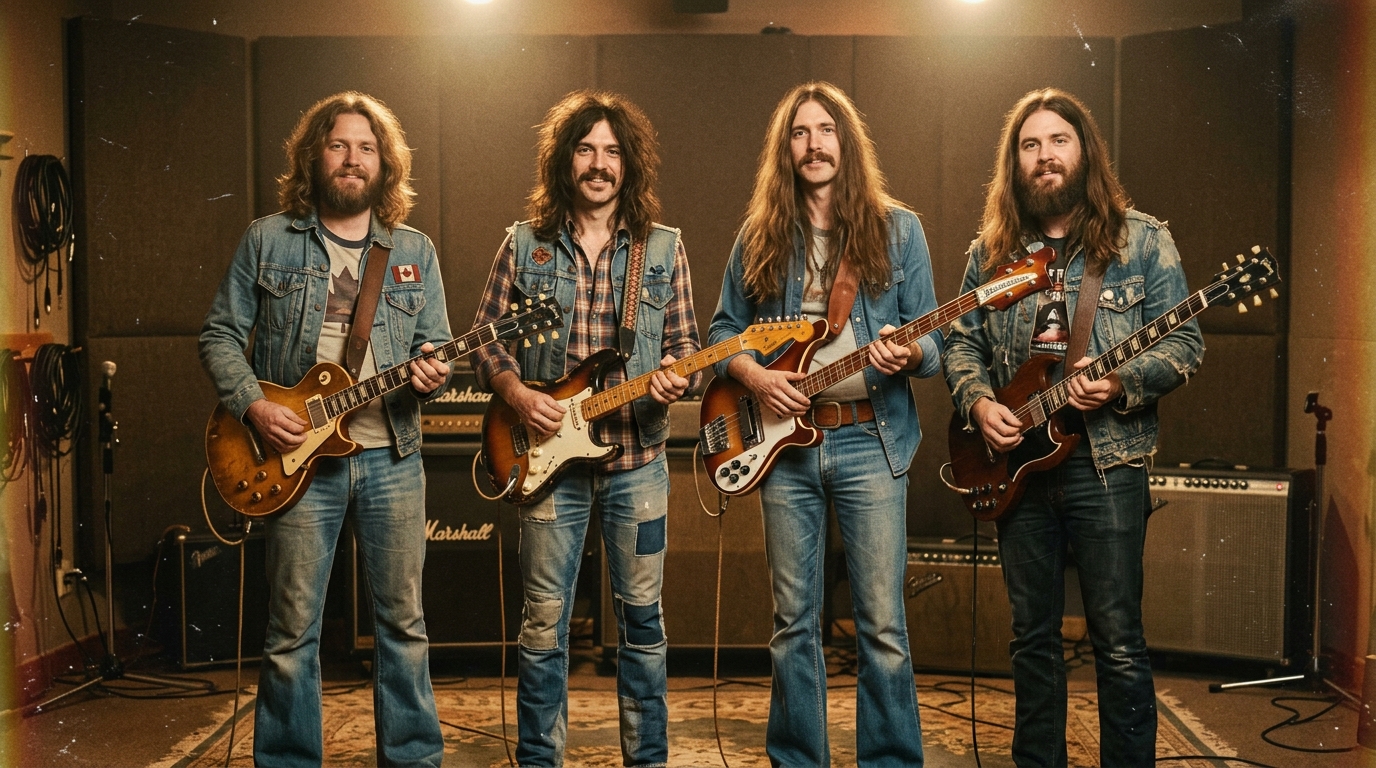
Some of the greatest moments in rock history are accidents. A guitar feedback loop becomes a signature sound. A mumbled lyric becomes a worldwide catchphrase. For Canadian rock band Bachman–Turner Overdrive, or BTO, their biggest and most enduring hit was never supposed to see the light of day. The song BTO you ain’t seen nothing yet was born not from a flash of artistic brilliance, but from a moment of private family humor. Randy Bachman, the band’s lead guitarist and primary songwriter, created the track as a one of a kind joke for his brother, who had a stutter.
What happened next is the stuff of rock legend. A record executive heard the demo, recognized its raw infectious energy, and fought to release it against the songwriter’s wishes. The song went on to become BTO’s only number one single in the United States, a staple of classic rock radio, and a timeless anthem. Its famous stuttering chorus has echoed through arenas, movies, and commercials for over five decades.
This is the story of how a private prank became a public phenomenon. It is a story of brotherly love, reluctant stardom, and the unpredictable magic of rock and roll. It also explores the phrase you ain’t seen nothing yet, tracing its journey from a vaudeville ad-lib to a rock anthem and beyond.
Quick Bio: Randy Bachman and BTO
| Attribute | Details |
|---|---|
| Band Name | Bachman–Turner Overdrive (BTO) |
| Origin | Winnipeg, Manitoba, Canada |
| Years Active | 1973–2005, 2009–2018 (various reunions) |
| Founding Member (Key Figure) | Randy Bachman (guitar, vocals, primary songwriter) |
| Other Core Members | Fred Turner (bass, vocals), Robbie Bachman (drums), Tim Bachman (guitar) |
| Randy Bachman’s Previous Band | The Guess Who (co-wrote American Woman) |
| Biggest Hit | You Ain’t Seen Nothing Yet (1974) |
| Chart Position | No. 1 on the US Billboard Hot 100 (November 9, 1974) |
| Album | Not Fragile (1974) – also reached No. 1 on the US Billboard 200 |
| Songwriter | Randy Bachman |
| Inspiration Behind the Song | A private joke poking fun at his brother Gary’s stutter |
The Accidental Origin: A Joke for a Brother
The story of BTO you ain’t seen nothing yet begins in a recording studio in 1974. Bachman–Turner Overdrive was in the middle of recording their third studio album, Not Fragile. They had already written and recorded eight tracks for the album. While fooling around during a break, Randy Bachman started playing an instrumental piece. The rhythm was inspired by the jangling guitars of Dave Mason’s Only You Know and I Know and the Doobie Brothers’ Listen to the Music. As he played, almost as a lark, he began improvising lyrics with a deliberate exaggerated stutter.
He was not trying to write a hit song. He was thinking of his older brother, Gary, who was the band’s manager. Gary had a noticeable stutter, a speech impediment that had been a source of teasing for him as a child. We thought, just for fun… we would take this song and I would stutter and we would send it to him, Bachman later explained. He will have the only copy in the world of this song by BTO. It was a private joke, an affectionate jab meant for an audience of one. Bachman copied his brother’s speech patterns. He copied the way his brother would say: you ain’t seen n-n-nothing yet, and also the way he stumbled on f-f-forget, and the way he said b-b-b baby.
At this point, BTO had no intention of including the track on their album. It was a fun diversion, a demo to be shared with family and then forgotten. But the accidental magic of the recording was undeniable. The song had a propulsive joyful energy that was different from the heavier blues rock that filled the rest of the album.
The song’s lyrics describe a meeting with a devil woman who takes the narrator’s heart away. In a notable twist, Bachman has stated that this devil woman or gentlewoman was actually his first wife, to whom he was married at the time. My first wife used to say to me, you ain’t seen nothing yet, he explained, revealing a deep personal layer behind the seemingly simple lyrics. The line I think that any love is good lovin is a simple philosophy that fits the song’s unpretentious good time vibe. The song was complete: a private family joke, built on a borrowed rhythm, with lyrics made up on the spot.
Breaking Down the Lyrics: A Devil Woman and a Memorable Chorus
The lyrics of You Ain’t Seen Nothing Yet are deceptively simple, yet they perfectly capture the song’s spirit. The song is built around a classic rock and roll scenario: a chance encounter with a mysterious and alluring woman. The narrator sings, I met a devil woman, she took my heart away, immediately setting the stage for a story of irresistible attraction. The devil woman archetype is a common trope in blues and rock music, representing a dangerous, passionate, and ultimately liberating force.
The verse continues, She said, I have had it coming to me but I wanted it that way. I think that any love is good lovin, so I took what I could get. These lines suggest a sense of acceptance and even eagerness to embrace the tumultuous experience the woman promises. There is a feeling of inevitability, a willingness to let go and see what happens. The narrator does not overthink the situation. This straightforward unapologetic attitude is at the heart of the song’s appeal.
However, the true magic of the song, and the source of its title, lies in the chorus. It is here that Randy Bachman’s private joke becomes the song’s defining feature. The chorus speaks of the woman looking at the narrator with big brown eyes and saying:
You ain’t seen n-n-nothin yet. B-B-B-Baby, you just ain’t seen n-n-nothin yet. Here’s somethin that you’re never gonna forget.
The stutter is not a gimmick. It infuses the line with a sense of anticipation, excitement, and a touch of vulnerability. The repetition of the hard B sound before baby acts as a musical hook, one of the most instantly recognizable and memorable in rock history. It turns a simple phrase into a triumphant staccato declaration. The devil woman is not just making a promise; she is issuing a playful confident challenge. The narrator, and by extension the listener, is about to experience something new and unforgettable bto you ain’t seen nothing yet.
The Reluctant Hit: From Private Joke to Number One
When the band finished recording Not Fragile, they played the album for Charlie Fach Junior, the Executive Vice President of A and R at Mercury Records. Fach liked the album but felt something was missing. He did not hear a clear hit single. Then, according to the story, the band’s engineer suggested they play the joke track for Fach. Bachman reluctantly obliged bto you ain’t seen nothing yet.
Charlie Fach was immediately captivated. bto you ain’t seen nothing yet He recognized the raw infectious energy of You Ain’t Seen Nothing Yet and was convinced it could be a smash hit. But Randy Bachman was horrified at the prospect. The song was a private embarrassment, a silly imitation of his brother. He felt it was beneath the band’s dignity as serious rock musicians and refused to let it be released.
A legendary standoff ensued. Fach had to plead with Bachman, first to include the song on the album at all and then to release it as a single. According to music historians, Fach had to plead with Randy Bachman, first to release You Ain’t Seen Nothing Yet at all and then to make it a single. The song embarrassed Randy; he did not want people to think he was making fun of his brother. An early attempt to re record the song without the stutter failed; it had lost its soul. Eventually, backed into a corner by his record label, Bachman relented.
The song was released as a single in September 1974. It debuted on the Billboard Hot 100 at number 65. Just seven weeks later, on November 9, 1974, the song had reached the top of the charts. You Ain’t Seen Nothing Yet became Bachman–Turner Overdrive’s first and only number one single in the United States. The private joke had become one of the biggest songs of the decade, much to the initial chagrin of its creator bto you ain’t seen nothing yet.
BTO: The Band Behind the Accidental Hit
To understand the full impact of the song, it is helpful to know a bit about the band that created it. Bachman–Turner Overdrive, or BTO, was a Canadian rock band formed in Winnipeg. The band was founded by Randy Bachman, a celebrated guitarist and songwriter who had already achieved massive success as a member of The Guess Who, for whom he co-wrote the iconic hit American Woman. After leaving The Guess Who, Bachman initially formed a band called Brave Belt. When that band struggled to find its footing, he overhauled its sound, transforming it into a high energy rock band with the help of bassist and vocalist Fred Turner. The new band was named Bachman–Turner Overdrive bto you ain’t seen nothing yet.
BTO’s sound was straightforward and powerful: a revved up bluesy and unpretentious hard rock often compared to the raw energy of Grand Funk Railroad. They were not a critics’ favorite, but they knew how to connect with a working class audience. They toured relentlessly, building a dedicated fan base through their live shows and receiving significant airplay on rock radio stations in the American Midwest. They toured hard and got love from rock radio stations in neglected Midwestern markets, a formula that proved very effective.
You Ain’t Seen Nothing Yet catapulted BTO from a respected album oriented rock band to a genuine pop phenomenon. The album Not Fragile also shot to number one on the US Billboard 200, becoming the group’s most popular studio album. While they had other hits, including Takin’ Care of Business and Roll on Down the Highway, none matched the chart topping success of their accidental anthem. The song remains the defining moment of their career, the track that ensured their place in rock history bto you ain’t seen nothing yet…
The Cultural Footprint: More Than Just a Song
The impact of You Ain’t Seen Nothing Yet extends far beyond the 1970s. The song has become a permanent fixture in popular culture. Its instantly recognizable stutter has been used in countless movies, television shows, and commercials to signify a moment of revelation or a surprising turn of events. A simple search will reveal its use in everything from comedy sketches to sports highlight reels bto you ain’t seen nothing yet.
The song has become a touchstone for discussions about stuttering as well. It has been described as an anthem that has helped change the lives of those who stutter. Rather than being a source of shame or mockery, the song’s famous chorus has been embraced by some in the stuttering community as a powerful and empowering piece of music. It takes a speech pattern that is often stigmatized and turns it into a symbol of cool rock and roll defiance. The phrase itself is a classic example of the idiom meaning that no matter what you have seen, what you are about to see will far top it.
It is also worth noting that You Ain’t Seen Nothing Yet is the title of a 2012 French film directed by the legendary Alain Resnais. The film is a meditative and highly theatrical piece about a group of aging actors who are summoned to pay tribute to a deceased playwright. It is a world away from the hard rock of BTO, but the title’s promise of something new and unexpected certainly applies bto you ain’t seen nothing yet.
The Phrase’s Journey: From Vaudeville to Rock and Roll
The phrase you ain’t seen nothing yet did not originate with Randy Bachman or BTO. Its history reaches back much further, to the very dawn of the sound era in cinema. The earliest popularization of the line is credited to the legendary vaudeville performer Al Jolson. In the groundbreaking 1927 film The Jazz Singer, the first full length talking picture, Jolson ad libs a variation of the phrase, telling the audience, you ain’t heard nothin yet bto you ain’t seen nothing yet.
The line was a boast, a promise that the technological marvel they were witnessing was just the beginning. Jolson’s confident colloquial delivery captured the excitement of a new era and the phrase quickly entered the popular lexicon. bto you ain’t seen nothing yet For decades, the expression has been used to signal that something even more impressive, shocking, or extreme is on the way. The use of ain’t and the double negative nothing gives the phrase a distinctively informal, almost rebellious flavor that other variations like you haven’t seen anything yet lack.
Over time, the phrase has been adopted in countless contexts: in sports commentary, political speeches, and advertising. When Randy Bachman chose it as the hook for his song, he was tapping into a phrase that already had deep cultural resonance. The combination of a powerful century old idiom with a modern rock riff created something truly timeless bto you ain’t seen nothing yet.
Legacy of an Accident: Why the Song Endures
So why does a silly accidental song written as a joke continue to resonate over 50 years later? The answer lies in its joyful authenticity. There is no pretension in You Ain’t Seen Nothing Yet. It is a song that does not take itself seriously, yet it is played with complete conviction. The stutter is not a put down; within the context of the song, it becomes a badge of honor, a unique vocal hook that no one else could have conceived. The song is, in its own way, a celebration of imperfection.
The story behind the song is also a big part of its charm. It is a quintessential rock and roll fable: the record executive fighting the reluctant artist, the private joke that became a global smash. This narrative of an accidental hit adds to the song’s mystique and makes it a more interesting artifact than a carefully calculated piece of pop music bto you ain’t seen nothing yet.
Furthermore, the song is simply a great rock record. The driving rhythm guitar, the simple but effective drumming, and Randy Bachman’s confident vocal delivery all combine to create an irresistible energy. It is a song designed to be played loud. The chorus, with its stuttering hook, is one of the most immediate and sing along friendly in rock history. These elements, combined with the song’s rich backstory and the deep history of its title phrase, ensure that You Ain’t Seen Nothing Yet will be a staple of classic rock radio for generations to come.
Conclusion
The story of BTO you ain’t seen nothing yet is a powerful reminder that the best moments in art are often unplanned. What began as a private affectionate joke aimed at a brother with a stutter became an unlikely anthem that has echoed through the decades. Randy Bachman’s embarrassment at the song was overcome by the persistence of a record executive who heard its undeniable magic. The result was BTO’s only number one single and a song that has become a permanent part of the cultural landscape.
From its humble origins as a studio goof, the track drew on a powerful phrase whose roots go back to the earliest days of talking pictures. Al Jolson’s boastful ad lib found new life in a driving rock riff. The song endures not in spite of its accidental nature, but because of it. It is a joyful unpretentious celebration of rock and roll’s power to take something unexpected and turn it into gold.
Ultimately, You Ain’t Seen Nothing Yet is a song about possibility. It is a challenge to the listener to expect more, to look forward to the next surprise. The devil woman in the lyrics promises something new, and over fifty years later, the song itself continues to deliver on that promise for each new generation of fans who hear its iconic opening chords bto you ain’t seen nothing yet.
Frequently Asked Questions
Q1: What is the origin of the song You Ain’t Seen Nothing Yet?
The song was written by Randy Bachman as a private joke for his brother Gary, who had a stutter. Bachman mimicked his brother’s speech pattern in the chorus. The band never intended to release it, but a record executive insisted after hearing the demo.
Q2: Was You Ain’t Seen Nothing Yet BTO’s only number one hit?
Yes. While BTO had several successful singles, including Takin Care of Business, You Ain’t Seen Nothing Yet is their only song to reach number one on the US Billboard Hot 100, doing so on November 9, 1974.
Q3: What is the meaning behind the lyrics of You Ain’t Seen Nothing Yet?
The lyrics describe a narrator who meets a devil woman who sweeps him off his feet. It is a playful and boastful song. Randy Bachman has said his first wife was the inspiration for the devil woman and would often say the title phrase to him.
Q4: Where did the phrase you ain’t seen nothing yet come from?
The phrase was popularized by entertainer Al Jolson in the 1927 film The Jazz Singer. As one of the first talking pictures, Jolson ad libbed the line you ain’t heard nothin yet, and the phrase soon became a popular idiom.
Q5: Is there a movie called You Ain’t Seen Nothing Yet?
Yes. It is the title of a 2012 French film by director Alain Resnais. The film is a drama about a group of veteran actors summoned after a playwright’s death and has no connection to the BTO song other than the shared title.