E-Z Wider – 1 1/2 is the flagship product of one of the most historically significant rolling paper brands in American tobacco culture. Founded in 1972 by Bob Stiller and Burton Rubin and named after the 1969 film Easy Rider, E-Z Wider was built around a single practical insight: smokers were already joining two standard papers together to get more width, and they deserved a purpose-built solution. The 1 1/2 size became the most commercially successful format in the brand’s lineup, delivering a wider paper with an even burn, natural gum arabic seal, and 24 leaves per booklet. This guide covers everything about E-Z Wider – 1 1/2 including its exact dimensions, history, material quality, variants, and where to find it today.
What Is E-Z Wider – 1 1/2
E-Z Wider – 1 1/2 is one of the most recognized rolling paper products in American tobacco and smoking culture. It is the flagship size of the E-Z Wider brand, a rolling paper company that became one of the defining products of the 1970s counterculture movement in the United States.
E-Z Wider is a brand of rolling papers introduced in 1972 by Bob Stiller and Burton Rubin. The name is derived from the 1969 film Easy Rider. E-Z Wider – 1 1/2.
The 1 1/2 designation refers to the width of the paper relative to standard single-wide rolling papers. This specific size became the most commercially successful format the brand offered and remains the most searched and purchased E-Z Wider product more than fifty years after the brand was first launched.
Since the 1970s, this iconic brand has been synonymous with quality, convenience, and a superior smoking experience. Designed with a wider format than standard rolling papers, E-Z Wider makes rolling effortless, even for beginners, while offering a smooth and even burn that seasoned smokers appreciate.
Understanding what makes the E-Z Wider – 1 1/2 size specific requires knowing where it sits within the broader landscape of rolling paper sizes, what the founding story behind the brand reveals about the problem it was designed to solve, and why it has maintained commercial relevance across decades of competition from newer brands with more modern branding and packaging E-Z Wider – 1 1/2.
The Origin Story of E-Z Wider Rolling Papers
The story of E-Z Wider begins not in a corporate boardroom but in a law school classroom in Miami, Florida, in 1969.
Burton Rubin came up with the idea for E-Z Wider in 1969 while attending Law School in Miami. Rubin noticed his smoking classmates were putting two leaves together to make double wide papers.
That observation was the founding insight. At the time, rolling papers were sold in standard single-wide sizes that most smokers found too narrow for their purposes. The workaround that had developed organically was to lick two papers together and join them side by side before rolling. This solved the width problem but created several new inconveniences: the join was imprecise, the double layer of paper in the middle of the joint burned unevenly, and the process was messy and time-consuming E-Z Wider – 1 1/2.
E-Z Wider offered smokers wider papers, so they did not have to lick and splice two papers together to make bigger joints.
The solution was elegantly simple: manufacture a single paper that was already the width two joined papers would create, but without the double layer in the middle. This gave smokers the width they wanted with an even thickness across the entire paper surface, resulting in a more consistent burn and a cleaner rolling experience E-Z Wider – 1 1/2.
Who Founded E-Z Wider and Why
Some time later Rubin met Bob Stiller through Rubin’s then wife. In 1971, Rubin wrote to over 11 European companies in hopes of beginning production. Manufactures Jean, a company located in Santander, Spain, responded. Bob Stiller invested the required funds for inventory with a loan from his father.
The founding partnership between Burton Rubin and Bob Stiller brought together complementary skills. Rubin had the original product concept and the legal and business knowledge from his law school background. Stiller brought the financial resources and the operational acumen that manufacturing a paper product at commercial scale required E-Z Wider – 1 1/2.
Rubin completed negotiations with French company Machines Chambon to buy an interleaving machine. This allowed the company to be less dependent on one source. Stiller became responsible for accounting and manufacturing.
The decision to source manufacturing from Spain and then bring production equipment in-house through a French-made machine reflected a sophisticated approach to supply chain independence. Rather than remaining entirely dependent on a single overseas manufacturer, the founders invested in production capability that gave them control over quality and capacity as demand grew E-Z Wider – 1 1/2.
In the 1970s, he launched E-Z Wider rolling papers to cater to marijuana smokers who wanted wider rolling papers than what was already on the market.
The timing was ideal. The early 1970s in the United States was a period of rapidly expanding cannabis use across a broad demographic that included college students, young professionals, and counterculture communities in both urban centers and university towns. The demand for better rolling papers was genuine and commercially significant E-Z Wider – 1 1/2.
What Does 1 1/2 Mean in Rolling Paper Sizing
Rolling paper sizing follows an industry-wide convention that uses numbers and fractions to describe the width of the paper relative to a standard single-wide baseline. Understanding this system explains exactly what you are getting when you purchase E-Z Wider – 1 1/2 papers.
The standard rolling paper sizes available in the market follow a clear progression:
- Single Wide (1.0): The smallest standard size, approximately 68 to 70 mm in length and 34 to 36 mm in width. Produces the narrowest roll.
- 1 1/4 Size: Slightly wider than single wide, approximately 76 to 78 mm long and 44 to 46 mm wide. The most commonly stocked size at most retailers.
- 1 1/2 Size: Wider still, approximately 76 to 78 mm long and 60 to 62 mm wide. This is the E-Z Wider flagship format.
- Double Wide (2.0): The widest standard format, approximately the width of two single-wide papers joined together.
- King Size and King Slim: Longer formats designed for extended rolling, with varying widths.
The 1 1/2 designation means the paper is approximately one and a half times the width of a standard single-wide paper. This extra width is precisely what Rubin and Stiller identified as the solution to the two-papers-joined-together workaround that smokers were already using before their product existed.
E-Z Wider – 1 1/2 Paper Dimensions and Specifications
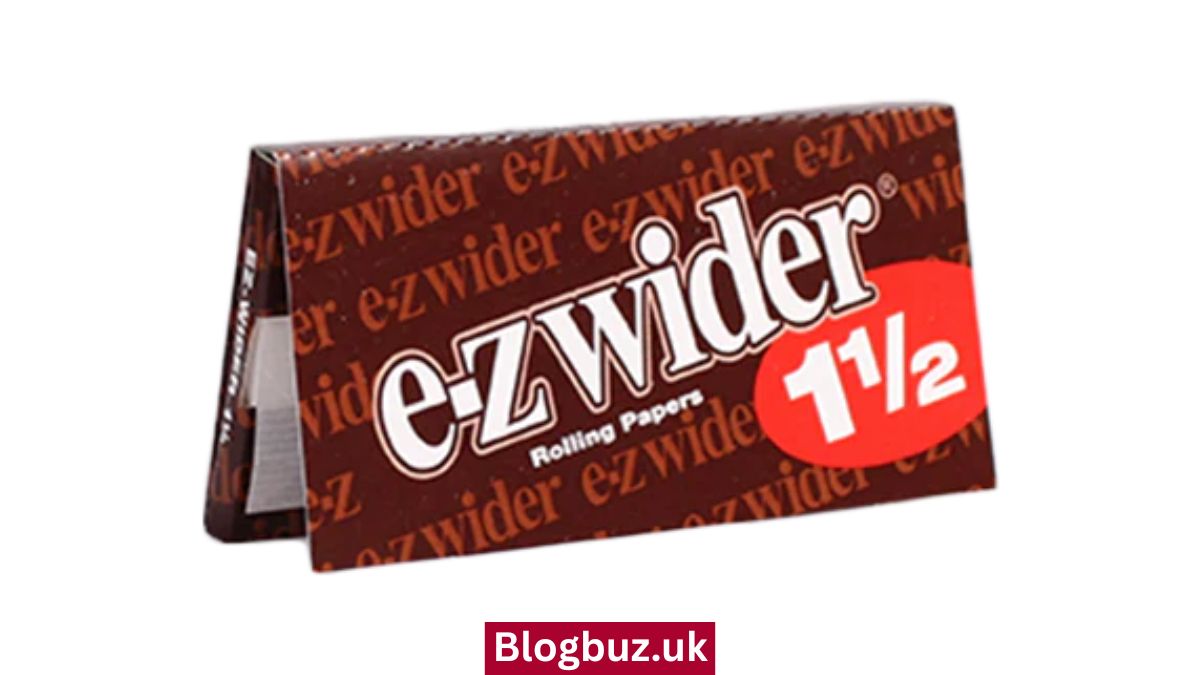
The E-Z Wider – 1 1/2 paper sits within the mid-wide category of rolling papers, offering more surface area than single-wide and 1 1/4 papers without reaching the full width of a double-wide format.
These rolling papers are 1 1/2 inch in size, making them perfect for rolling up a big one. The clean burning quality ensures that you get the most out of your smoking experience.
Key specifications for the E-Z Wider – 1 1/2 include:
- Paper width: Approximately 60 to 62 mm
- Paper length: Approximately 76 to 78 mm
- Leaves per booklet: 24 leaves
- Booklets per display box: 24 booklets
- Total leaves per box: 576 leaves
- Gum type: Natural gum arabic
- Manufacturing origin: Belgium (current production)
- Paper color: Classic brown (unbleached) and white variants available
- Burn quality: Slow and even
Natural plant-based material provides a clean and smooth smoking experience. Trusted brand with decades of reputation for quality and reliability.
The 24-leaf booklet format is standard across the rolling paper industry. The 24-booklet display box format makes E-Z Wider – 1 1/2 practical for retail stocking because the gravity-feed display box allows booklets to be accessible to customers while keeping the remaining stock organized behind each one.
How E-Z Wider – 1 1/2 Compares to Other Sizes
The E-Z Wider – 1 1/2 occupies a specific and popular position within the E-Z Wider product lineup. Understanding where it sits relative to the brand’s other formats helps clarify why this particular size has remained the most commercially successful.
Single-wide papers are the smallest format E-Z Wider produces. They are practical for minimal tobacco rolls but were never the target product for the brand, which was built specifically around the wider format concept. The 1 1/4 size gives a moderate amount of additional space over single wide, which suits lighter rolls and users who prefer a narrower finished product.
The 1 1/2 size hits the practical sweet spot that Rubin identified in his Miami law school observation. It is wide enough to eliminate the need for joining two papers but not so wide that excess paper is wasted around a roll that does not fill the available width. This balance between adequate space and efficient use of the paper is what made the 1 1/2 the most commercially successful size.
The double-wide format is the maximum width available in the line. It produces the widest possible roll but requires more skill to roll evenly and can result in excess paper if the roll is not packed tightly enough to fill the full width.
One of the things we realized was that the paper was a little bit too wide and we started doing a little bit narrower width. I think that was one of the first things that we changed and went to a 1 1/2 size paper.
This quote from Bob Stiller directly confirms that the 1 1/2 size was the result of refinement based on actual use feedback. The founders started with a wider paper and narrowed it to the 1 1/2 dimension after discovering that users found the original width excessive. The 1 1/2 was not an arbitrary size choice but a data-driven product decision.
Materials and Construction of E-Z Wider Papers
The material quality of a rolling paper directly affects its burn rate, taste, and overall smoking experience. E-Z Wider has consistently emphasized natural materials as a core product value since its founding.
Initial production began in Spain and used gum arabic which contains no artificial ingredients.
Gum arabic is a natural plant-based adhesive derived from the Acacia tree. It has been used as a food-grade adhesive for centuries and produces no chemical taste or smell when moistened and applied. Its use in rolling papers is preferred by quality-focused consumers specifically because it does not introduce artificial flavors or chemical compounds into the smoking experience.
For those who are conscious about what they inhale, E-Z Wider also offers unbleached and ultra-thin variants. These options minimize the presence of additives and chemicals, allowing you to enjoy the pure, unaltered taste of your herbs or tobacco.
The classic brown paper variant that E-Z Wider is most historically associated with is the unbleached format. The brown color is the natural color of the plant-based paper material before any bleaching process is applied. Many experienced smokers prefer unbleached papers specifically because the absence of a bleaching process means no chlorine or chemical bleaching agents are present in the paper.
The paper is manufactured using a process that produces a consistent thickness throughout the entire sheet, which is what enables the even burn that E-Z Wider is known for. An uneven thickness would cause the paper to burn faster in thinner areas, creating a canoeing effect where one side burns ahead of the other.
Why the 1 1/2 Size Became the Most Popular
The commercial dominance of the E-Z Wider – 1 1/2 within the brand’s lineup comes down to the practical reality of how rolling papers are actually used.
Most people who roll their own cigarettes or tobacco products are working with a quantity of material that fits most naturally into a 1 1/2 width paper. The single-wide format is genuinely too narrow for comfortable rolling for most users. The double-wide format is wider than the average quantity of material requires, which means either packing more material than desired or ending up with excess paper that burns without any material inside.
The 1 1/2 size avoids both problems. It provides enough width to roll comfortably without requiring expert technique, and it accommodates a reasonable quantity of material without leaving significant empty paper at the edges of the roll.
Designed with a wider format than standard rolling papers, E-Z Wider makes rolling effortless, even for beginners, while offering a smooth and even burn that seasoned smokers appreciate.
The beginner accessibility dimension is significant. Rolling technique improves with practice, and beginners consistently struggle with narrow papers because the limited width means less room for error. The 1 1/2 width gives beginners more working space, which translates directly into a higher success rate on early rolling attempts and builds brand loyalty among users who associate their first positive rolling experiences with E-Z Wider papers.
The Cultural Impact of E-Z Wider in the 1970s
E-Z Wider arrived at a moment in American cultural history when the product it was designed to serve was moving from the margins of society toward the mainstream.
The 1970s in the United States saw cannabis use expand significantly beyond the counterculture communities where it had been concentrated in the 1960s. College campuses, suburban neighborhoods, and professional workplaces all saw increasing use during this decade, creating a commercial market that was genuinely large and growing.
Stiller’s timing was good, and when he sold the company in 1980, he personally pocketed $3.1 million.
The brand name itself was a cultural reference that aligned the product with the counterculture identity of its target audience. The name E-Z Wider, derived from the 1969 Peter Fonda film Easy Rider, connected the product to one of the most iconic pieces of countercultural cinema in American history. Easy Rider was not merely a film about motorcycles. It was a statement about freedom, nonconformity, and the tension between individual expression and social convention. Naming a rolling paper brand after it was a deliberate signal about who the product was for and what values it represented.
How Bob Stiller Built a $7 Million Business from Rolling Papers
After 6 years of operation E-Z Wider had annual turnover of $7 million.
Building a seven-million-dollar annual turnover business from a single rolling paper product in six years during the 1970s was a genuine entrepreneurial achievement. The rolling paper market was niche, regulatory pressure around cannabis-related products was significant, and distribution through conventional retail channels was complicated by the dual-use nature of the product.
Under Stiller’s leadership, E-Z Wider quickly gained a reputation for quality and customer satisfaction. The company’s market share grew steadily, and Stiller honed his skills in areas such as supply chain management, product development, and brand building.
The business lessons Stiller learned running E-Z Wider, specifically around supply chain management, product refinement based on user feedback, and brand-building in a niche market, directly informed his subsequent and far more famous success with Green Mountain Coffee Roasters. The entrepreneurial frameworks he developed selling rolling papers were portable to the coffee industry, and Stiller himself has acknowledged this connection in interviews and his book.
The Sale of E-Z Wider to Rizla
As the high flying days of the 1970s came to a close, Stiller and his partner Burton Rubin sold the company to English tobacconeer Rizla for $6.2 million.
The sale to Rizla, one of the oldest and most established rolling paper manufacturers in the world, placed E-Z Wider within a global tobacco products portfolio. Rizla brought the distribution infrastructure and category expertise of a major international company to a brand that had been built by two entrepreneurial individuals operating with bootstrapped resources.
When he sold the company in 1980, he personally pocketed $3.1 million.
The brand has passed through several ownership structures since the Rizla acquisition but has remained in production continuously, which is itself a testament to the durability of its commercial position. More than fifty years after its founding, E-Z Wider – 1 1/2 papers are still manufactured, still stocked by retailers across the United States, and still searched by consumers who recognize the brand name from decades of market presence.
E-Z Wider – 1 1/2 Product Variants Available Today
The current E-Z Wider product range includes several variants within the 1 1/2 size category:
- E-Z Wider – 1 1/2 Classic Brown: The original unbleached format, the product most associated with the brand’s founding era. Natural brown color, gum arabic seal, 24 leaves per booklet.
- E-Z Wider – 1 1/2 White: A bleached white paper variant for users who prefer the aesthetic of white papers. Same dimensions and leaf count as the classic brown.
- E-Z Wider – 1 1/2 Gold: A premium variant with refined paper quality marketed to more experienced rollers.
- E-Z Wider – 1 1/2 Double Wide: A wider variant for users who want maximum rolling width within the E-Z Wider family.
Whether you prefer classic slow-burning papers or ultra-thin options for a more natural smoking experience, E-Z Wider delivers premium quality in every sheet.
How to Roll with E-Z Wider – 1 1/2 Papers
Roll up your favorite herb with ease using the EZ Wider Rolling Papers. Rolling a joint with E-Z Wider Rolling Papers is a breeze. Follow these simple steps to achieve a perfectly rolled joint every time: Grind your herb to a desired consistency. Spread the ground herb evenly on the E-Z Wider Rolling Paper. Roll the paper between your fingers, shaping it into a cylinder. Lick the gum strip and seal the joint securely. To prevent any loose herb from falling out, pack the end of the joint with a filter or crutch.
The wider format of the 1 1/2 paper is particularly forgiving during the rolling step. The additional width means the paper has more surface area to work with when you are shaping the roll between your fingers, which reduces the likelihood of the roll losing its shape or tearing during the sealing step.
E-Z Wider – 1 1/2 vs Competing Brands
The rolling paper market in 2026 is significantly more competitive than it was when E-Z Wider launched in 1972. Several major brands now compete directly in the same size category:
- RAW 1 1/2: An unbleached natural paper brand that has become the dominant brand in the premium rolling paper segment since its founding in 2005.
- OCB 1 1/2: A French brand with a long history in the European market that competes on ultra-thin paper technology.
- Bambu 1 1/2: A brand with historical roots similar to E-Z Wider that competes in the traditional paper segment.
- Zig-Zag 1 1/2: One of the oldest rolling paper brands in the world, competing across all standard sizes.
E-Z Wider’s competitive position rests on brand recognition and the loyalty of consumers who have used the product for years or decades. Its price point is typically competitive with mainstream brands rather than positioned as a premium product, which makes it accessible to a broad range of consumers.
Where to Buy E-Z Wider – 1 1/2 Papers Today
At Smoker’s Outlet Online, we understand that smokers want high-quality rolling papers at great prices, and that’s exactly what we offer. Our collection of E-Z Wider Rolling Papers includes various sizes and options to cater to every smoker’s preference.
E-Z Wider – 1 1/2 papers are available through several distribution channels:
- Online retailers: Amazon, DankGeek, Smoker’s Outlet Online, and other tobacco and smoking accessory retailers stock the full E-Z Wider range with delivery to most US states.
- Convenience stores and gas stations: Many convenience stores that carry rolling papers stock E-Z Wider alongside other major brands.
- Liquor stores: Many liquor stores in states where rolling papers are sold carry E-Z Wider in the 1 1/2 size.
- Tobacco specialty shops: Head shops and tobacco specialty retailers typically carry the full E-Z Wider product range.
- Display box format: The 24-booklet gravity-feed display box format makes the product a standard retail stocking unit that fits easily into existing tobacco accessory displays.
Collector Value and Vintage E-Z Wider Papers
For collectors and smokers who appreciate quality rolling papers, these vintage E-Z Wider papers are a must-have. Made by a reputable brand known for their wide selection of tobacco products, these papers are sure to impress.
Vintage E-Z Wider papers from the 1970s and early 1980s have developed a collector following among people interested in counterculture memorabilia and tobacco ephemera. Original packaging from the brand’s early years reflects the graphic design conventions of that era and carries the nostalgia value that all counterculture products from the 1970s have accumulated.
These Are Not Your Father’s Rolling Papers. Oh, I am Sorry, Yes They Are!
That line of marketing copy captures the dual audience that vintage E-Z Wider products attract: both original users from the 1970s who remember the brand from its cultural peak and younger collectors who value the historical and aesthetic significance of the packaging and branding from that era.
Conclusion
E-Z Wider – 1 1/2 is more than a rolling paper product. It is an artifact of American entrepreneurial and counterculture history that has maintained commercial relevance across more than five decades. The insight that launched the brand, that smokers were already creating wider papers by joining two together and deserved a purpose-built solution, was simple, practical, and commercially valid.
Bob Stiller’s entrepreneurial journey began in the early 1970s when he co-founded E-Z Wider, a company that manufactured rolling papers for tobacco products. Under Stiller’s leadership, E-Z Wider quickly gained a reputation for quality and customer satisfaction.
The 1 1/2 size specifically became the brand’s defining product because it hit the practical sweet spot between too narrow and too wide, a balance that Stiller confirmed was reached through actual product refinement based on user feedback rather than arbitrary sizing. After 6 years of operation E-Z Wider had annual turnover of $7 million, validating the commercial power of a simple product that solved a real problem better than anything that existed before it.
Today, E-Z Wider – 1 1/2 papers remain available at retailers across the United States in classic brown and white variants, still carrying the brand identity and quality standards that Bob Stiller and Burton Rubin established when they launched production from Spain in 1972. For anyone interested in rolling papers with genuine historical depth behind them, E-Z Wider – 1 1/2 remains one of the most storied names in the category.
Frequently Asked Questions
Q1. What is E-Z Wider – 1 1/2?
E-Z Wider is a brand of rolling papers introduced in 1972 by Bob Stiller and Burton Rubin. The 1 1/2 size rolling papers are 1 1/2 inch in size, making them perfect for rolling, with clean burning quality ensuring you get the most out of your smoking experience.
Q2. Who founded E-Z Wider rolling papers?
E-Z Wider is a brand of rolling papers introduced in 1972 by Bob Stiller and Burton Rubin. The name is derived from the 1969 film Easy Rider.
Q3. What does the 1 1/2 size mean in rolling papers?
The 1 1/2 designation refers to a paper width approximately one and a half times wider than a standard single-wide paper, the result of refinement from an even wider original format, changed to a 1 1/2 size paper after founders realized the original width was too wide.
Q4. How many papers come in an E-Z Wider – 1 1/2 booklet?
Each package contains 24 booklets with 24 leaves each, for a grand total of 576 rolling papers per display box.
Q5. What material are E-Z Wider papers made from?
Initial production began in Spain and used gum arabic which contains no artificial ingredients. Natural plant-based material provides a clean and smooth smoking experience.